
About Us
About
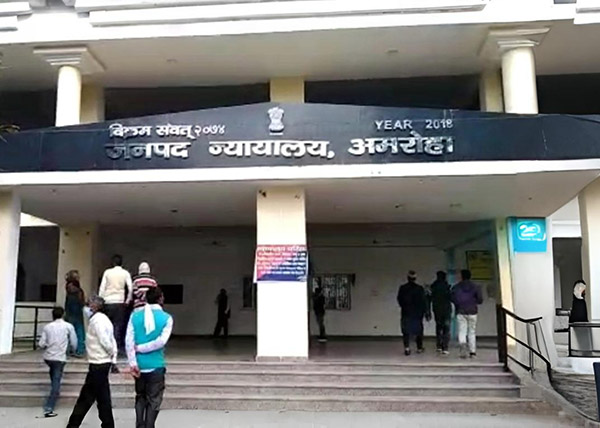
Amroha District Court
The Amroha District Court, also known as the District & Sessions Court, Amroha, is the principal judicial body for the district of Amroha in the state of Uttar Pradesh, India. Established concurrently with the creation of the Amroha district, the court serves as a cornerstone for the administration of justice in the region.
The territorial jurisdiction of the Amroha District Court extends over the four tehsils (sub-districts) of Amroha:
- Amroha
- Dhanaura
- Hasanpur
- Naugawan Sadat
The court functions under the administrative control of the Hon’ble High Court of Judicature at Allahabad. It is comprised of a District & Sessions Judge, who is the highest judicial authority in the district, along with a cadre of Additional District & Sessions Judges, Civil Judges (Senior and Junior Divisions), and other judicial officers who preside over a variety of civil and criminal cases.
History of the Amroha District and Its Judiciary
The history of the judiciary in Amroha is intrinsically linked to the history of the district itself.
Creation of the District:
The district of Amroha, formerly known as Jyotiba Phule Nagar, was carved out from the Moradabad district and came into existence on April 15, 1997, by a notification from the Government of Uttar Pradesh.5 Initially, it comprised the three tehsils of Amroha, Dhanaura, and Hasanpur. Later, Naugawan Sadat was added as the fourth tehsil.
Establishment of the Judgeship:
With the formation of the new district, a separate and independent Judgeship for Amroha was created on the same day, April 15, 1997. Prior to this date, the area constituting the present-day Amroha district fell under the jurisdiction of the Moradabad District Court. The establishment of the District Court in Amroha was a significant step in making justice more accessible to the local populace.
Historical Context of the Region:
The land of Amroha has a rich and varied history that predates the establishment of the district and its court system by centuries.
- Ancient Period: The region was a part of the ancient North Panchala kingdom.
- Medieval Period: It witnessed the rule of various dynasties, including the Rajputs. The area was also under the influence of the Delhi Sultanate and the Mughal Empire. Historical records indicate that during the reign of Mughal Emperor Shah Jahan, a fort was built in the region by Rustam Khan, the thengovernor of Sambhal.
- British Era: In 1801, the administration of this territory was ceded to the British East India Company by the Nawab of Awadh.6 From then until India’s independence, the judicial system in the area was administered as per the legal framework established by the British.
The Bar Association of Amroha
The Bar Association of Amroha is an active and integral part of the legal landscape of the district. It represents the community of lawyers practicing in the Amroha District Court and its subordinate courts.
About the Bar Association:
While a detailed historical account of the Bar Association of Amroha is not readily available in public records, it is understood to have been functioning in some form since the inception of the judgeship. The association plays a crucial role in:
- Upholding the dignity and independence of the bar and the judiciary.
- Promoting the welfare and professional interests of its members.
- Ensuring access to justice for all sections of society.
- Organizing legal aid programs and other activities to enhance legal awareness.